Shanghai — where mahjong solitaire came from Runs here
1986 · Activision · System 6 · Mini vMac (Mac Plus) · 512×342 black and white
Guide updated September 2026
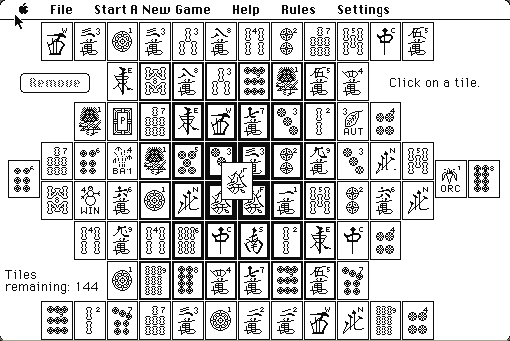
If you have ever cleared a pile of mahjong tiles by matching free pairs, you have played a copy of this. Shanghai is where that layout came from — not a folk game, not a traditional pastime, but a specific piece of software written by one person in 1986.
This is the Macintosh version, booting from its own floppy, in black and white, with the tile set drawn small enough to fit a compact Mac's screen.
Boots from the original floppy on an emulated Macintosh Plus. Click one free tile, then a matching free tile, and they both go.
Controls
| Mouse | Click a tile, then its match. Both have to be free. |
| Menus | New game, layout, hints and the tournament mode |
| Cmd-Q | Quit |
Shanghai was written by Brodie Lockard and published by Activision in 1986. Activision still exists and has sold Shanghai games since, but not this one — the 1986 Macintosh release has not been distributed by anyone in nearly forty years. The tile layout it invented is now a public genre with hundreds of free implementations; this page is about the original artefact. Full reasoning is in notices/shanghai.md, and the takedown promise applies without argument.
Archives
- Internet Archive — the preserved 1986 Macintosh floppy this copy boots from.
- Macintosh Garden — other releases and documentation.
How it works & what to expect
| Machine | Macintosh Plus, 512×342 black and white |
|---|---|
| System | The floppy's own — this disk boots itself |
| Emulator | Mini vMac, compiled to WebAssembly |
| Version | 1.0, the Macintosh release |
| Saves | Inside the emulated Mac, in your browser. Do not keep anything irreplaceable there. |
Like Rogue, this one boots from the original disk rather than from a System 7 hard disk, because the 1986 application does not survive System 7.5.3 — it takes the machine down with it. The floppy carries its own System and names Shanghai as the startup program, so the emulated Mac Plus comes up directly in the game.
A tile is free if nothing sits on top of it and at least one of its left or right edges is clear. Click two free tiles that match and they are removed. Clear all 144 and you have won, which happens less often than you would think.
Not actually mahjong
Shanghai uses a mahjong tile set and almost nothing else from mahjong. The real game is a four-player game of draws and discards with scoring rules that take a while to learn. What Brodie Lockard built is a solitaire puzzle that happens to use the same 144 tiles.
Lockard based the layout on a design he had read about — the "turtle" arrangement — and wrote the first version on the PLATO system while recovering from a gymnastics accident that had left him almost entirely paralysed. Activision picked it up and published it on the Macintosh in 1986.
It is worth saying plainly because the misunderstanding is so widespread: this is a 1986 computer game with an inventor, not an ancient Chinese pastime. The confusion is itself a measure of how completely it took over.
Why it is not always winnable
The tiles are dealt into the layout at random, and the game does not check that the deal can be solved. Some deals cannot be. You can play perfectly and still reach a board with four tiles left where the only pair is stacked on itself.
Later mahjong solitaire games usually guarantee a solvable deal, which makes them fairer and slightly less interesting. Here, part of the skill is reading the board early — clearing the tiles that unlock the most, and being careful about breaking up a set of four when the other two are buried.
Questions people ask
Is this the original mahjong solitaire?
Yes. Brodie Lockard wrote it, Activision published it in 1986, and every mahjong solitaire game since is a descendant of this layout.
Is it really mahjong?
No. It borrows the tiles. Mahjong proper is a four-player game with draws, discards and scoring; this is a solitaire puzzle that uses the same tile set.
Why can I not always win?
Because the deal is not checked for solvability. Some boards are dead from the start, which is a genuine property of the original and not a fault in the emulation.
Why does it boot straight into the game?
The floppy names Shanghai as the startup program rather than the Finder, so the machine comes up in the game. The 1986 application will not run under System 7 at all, so this is also the only way it works.
How do I know if a tile is free?
Nothing on top of it, and nothing immediately to its left or immediately to its right. A tile with neighbours on both sides is locked even if it is on the top layer.
Can I keep a game in progress?
Only inside the emulated Mac, which lives in your browser. It survives closing the tab and does not survive clearing site data.