Pipe Dream — lay it faster than it flows Runs here
1990 · LucasArts · System 6 · Mini vMac (Mac SE) · 512×342 black and white
Guide updated September 2026
A grid, a starting pipe, and a queue of random pieces you have to use in the order they arrive. In a few seconds the flow starts, and from then on you are laying track in front of a train you cannot stop.
This is the Macintosh version, with the high score table, the two-player mode and the Trainer setting that lets you practise without the clock.
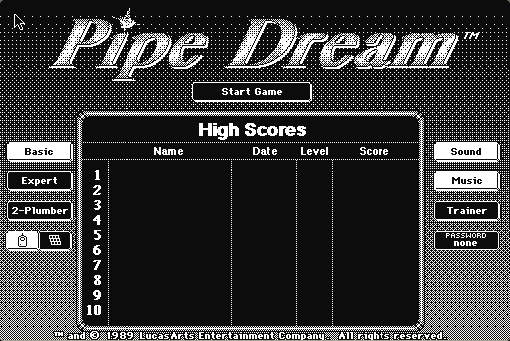
Boots straight to the Pipe Dream title screen on an emulated Macintosh SE. Pick Basic, Expert or 2-Plumber and click Start Game.
Controls
| Mouse | Click a square to place the next piece from the queue |
| Click an existing pipe | Replaces it, at a time penalty — use this sparingly |
| Basic / Expert / 2-Plumber | Difficulty, and the two-player mode |
| Trainer | Practice without the flow starting |
| Cmd-Q | Quit to the Finder |
Pipe Dream was written by The Assembly Line and published in the United States by LucasArts in 1990. The concept has been remade many times — Pipe Mania and others — and those remakes are current products. This Macintosh build is not: no one has sold it in over thirty years. Full reasoning is in notices/pipe-dream.md, and the takedown promise applies without argument.
Archives
- Internet Archive — the preserved Macintosh floppies this copy came from.
- Macintosh Garden — other releases and documentation.
How it works & what to expect
| Machine | Macintosh SE, 512×342 black and white |
|---|---|
| System | System 7.5.3 |
| Emulator | Mini vMac, compiled to WebAssembly |
| Version | 1.2, the Macintosh release |
| Saves | High scores live inside the emulated Mac, in your browser. |
You do not choose your pieces. A queue down the side of the screen shows what is coming, and you must place the next one somewhere before you can see past it. That single rule is what turns a simple idea into a real game: you are always building with the wrong piece and planning around the two you can see.
The flow starts after a short delay and never stops. Reach the required length of pipe before it runs out and you go on to the next level, where it starts sooner and moves faster.
How to be good at it
Build long, not direct. The target is a length of pipe, not a destination. A tight spiral in a corner scores the same as a sprawl and takes far less space.
Waste pieces deliberately. A piece you cannot use goes somewhere out of the way, not into your path. Placing a bad piece badly is the most common way to lose.
Use the crossover pieces. The one that carries flow in both directions is worth planning around — it lets your pipe cross its own run and is the basis of every long score.
Replacing costs time. You can drop a new piece on an existing one, and the flow keeps moving while you do. It is an emergency measure, not a strategy.
Where it came from, and where it went
The Assembly Line, a small British studio, wrote it for the Amiga in 1989 as Pipe Mania. LucasArts published it in the United States as Pipe Dream, which is the name most people know and the name on this build.
It then spread further than almost any puzzle game of its generation, largely by being copied. The pipe-laying minigame that turns up in BioShock, in half the hacking sequences in games since, and in an enormous number of mobile titles is this, more or less unchanged. It became a piece of shared vocabulary rather than a game people remembered buying.
The original is a tighter thing than any of its descendants: no story around it, no reward screen, just a grid, a queue, and water that is already moving.
Questions people ask
Is this Pipe Mania?
Same game. The Assembly Line released it as Pipe Mania in Europe; LucasArts published it in the United States as Pipe Dream, and this is that build.
Can I choose which piece to place?
No, and that is the game. You get the next piece in the queue and can see a few ahead, so the skill is in building something that will accept whatever arrives.
How do I get a long score?
Spiral. The goal is total pipe length, not reaching a particular spot, so a dense coil in one corner beats a neat run across the board.
What is Trainer mode?
Practice with the flow switched off, so you can learn the pieces without the clock. It is on the title screen.
What is 2-Plumber?
The two-player mode, taking turns on the same machine.
Are high scores kept?
Inside the emulated Mac, which lives in your browser. They survive closing the tab and not clearing site data.