Rogue — the Macintosh one, with pictures Runs here
1985 · Epyx / A.I. Design · System 6 · Mini vMac (Mac Plus) · 512×342 black and white
Guide updated September 2026
Everyone who has played a roguelike has played a descendant of this. Rogue invented the whole shape of it in 1980 — a dungeon generated fresh every time, permanent death, and items whose identity you have to work out by using them and finding out.
The original was letters on a terminal. This is the 1985 Macintosh version, where A.I. Design threw away the letters and drew everything. The dungeon is the same dungeon, and it still kills you.
Boots from the original 1985 floppy on an emulated Macintosh Plus, exactly as it shipped: type a name, click Play Rogue, and go down.
Controls
| Arrow keys | Move one square, or attack what is next to you |
| Mouse | Click a square to move there; click an item to pick it up |
| Menus | Inventory, wielding, wearing, reading, quaffing, throwing |
| > | Go down the staircase |
| Cmd-Q | Quit — which saves and ends the run |
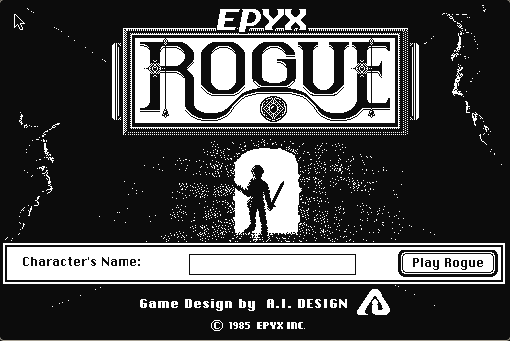
Rogue began in 1980 as a free game written by Michael Toy, Glenn Wichman and Ken Arnold, and the original BSD source has been freely available for decades. This is not that: it is the 1985 commercial Macintosh port A.I. Design made for Epyx, which redrew the whole game in icons. Epyx went bankrupt in 1993, its catalogue scattered, and no one has sold this version in forty years. Full reasoning is in notices/rogue.md, and the takedown promise applies without argument.
Source and archives
- Internet Archive — the preserved 1985 Macintosh floppy this copy boots from.
- The Rogue Archive — source and binaries for the original versions across every platform it reached.
How it works & what to expect
| Machine | Macintosh Plus, 512×342 black and white |
|---|---|
| System | The floppy's own — this disk boots itself |
| Emulator | Mini vMac, compiled to WebAssembly |
| Version | The 1985 Epyx release for the Macintosh |
| Saves | Inside the emulated Mac, in your browser. Do not keep anything irreplaceable there. |
This one runs differently from most of the catalogue, and the difference is worth explaining. Nearly every title here is copied onto a System 7 hard disk that boots and then launches it. Rogue will not tolerate that — launch it under System 7.5.3 and it takes the whole machine down hard enough that the Mac resets and asks for a startup disk.
It does not need one. The original floppy names Rogue itself as the startup program, where a normal disk names the Finder. There is no desktop, no menu bar you did not ask for, no Finder at all: the machine boots directly into the game, which is exactly what a 1985 Epyx disk did. So that is how it runs here, on a Macintosh Plus, from the disk as it shipped.
What you are actually playing
You are in a dungeon of twenty-six levels looking for the Amulet of Yendor, which is on the bottom. Then you have to carry it back up. Almost nobody does.
Every floor is generated when you arrive, so there is nothing to memorise and no map to look up. Potions and scrolls are unidentified — a potion is "a blue potion" until you drink one, and it might heal you or blind you. Monsters are lettered in the original and drawn here, and they get worse as you descend: the kestrel on level two is a nuisance, and the dragon on level twenty is not.
Death is permanent. There is no reloading a good save, because the save is deleted when you resume it. That rule is the reason the genre exists, and it is the reason a run feels like it matters.
Why this version looks different
Rogue was written for terminals, so it was made of letters: @ was you, Z was a zombie, and a room was drawn in dashes and pipes. That constraint became the genre's signature, and plenty of modern roguelikes still choose it deliberately.
A.I. Design ported Rogue to the IBM PC and then the Macintosh for Epyx, and on a Mac in 1985 you had a bitmapped screen and a mouse, so they used them. The monsters are little drawings. The dungeon is drawn in a tile set. You can click where you want to walk. It is the same game underneath — same generator, same identification puzzle, same permadeath — wearing the only interface the Macintosh had.
It is also a small piece of history in its own right: one of the earliest examples of a text-only game being rebuilt around a graphical interface rather than simply given a font.
Questions people ask
Is this the original Rogue?
It is the original game in its 1985 Macintosh clothes. The 1980 original was letters on a terminal; this is the commercial Macintosh port A.I. Design made for Epyx, with the same dungeon generator and rules.
Why does it boot straight into the game with no desktop?
Because the floppy names Rogue as the machine's startup program instead of the Finder. It was a self-booting game disk, and it still is.
Why a Macintosh Plus and not something newer?
Because it does not survive anything newer. Under System 7.5.3 it crashes the machine outright. On the Mac Plus, with the System that shipped on the disk, it runs as it always did.
Can I save and come back?
You can save, and resuming deletes the save — which is the rule the whole genre is built on. Saves also live inside your browser's copy of the emulated Mac, so treat them as temporary.
How far down is the Amulet?
Level twenty-six. Getting there is the first half of the game; carrying it back up to the surface is the half nobody talks about because so few people see it.
What should I do first?
Read the scrolls and drink the potions you find while you are still shallow and they cannot kill you. Learning what a blue potion does on level two is much cheaper than finding out on level fifteen.