The King of Chicago — you choose what he thinks Runs here
1986 · Doug Sharp / Cinemaware · System 7 · Mini vMac (Mac SE) · 512×342 black and white
Guide updated September 2026
Chicago, the end of Prohibition, and you are a young mobster trying to take the North Side from the old boss. The game plays as a film: scenes cut between locations, characters talk, and at intervals you are offered a set of thoughts your character might have — and choosing one is how you act.
Choosing what someone thinks rather than what they do was Doug Sharp's idea and remains unusual. It also means the game moves on whether or not you decide, which gives the whole thing a pace that most 1986 adventures did not attempt.
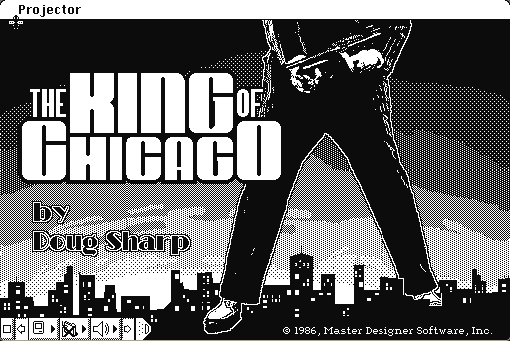
Boots to the Projector window and the title card. The story starts on its own; watch for the thought bubbles.
Controls
| Mouse | Pick a thought from those offered, and act on the map screens |
| Menus | Save, restore, and adjust the presentation |
Cinemaware was wound up in 2014 and its catalogue has moved through several hands. No re-release contains the 1986 Macintosh build and it has not been sold in over thirty years. This is among the less settled rights positions here and comes down on any colourable claim.
Archives
- Internet Archive — the Macintosh floppy this copy was made from.
How it works & what to expect
| Machine | Macintosh SE, 512×342, black and white |
|---|---|
| System | System 7.5.3 — see the note below |
| Emulator | Mini vMac, compiled to WebAssembly |
| Saves | Inside the emulated Mac, in your browser |
The story is different each time. Cinemaware built it around a scene-selection system rather than a fixed script, so a second play is genuinely a different film rather than the same one faster.
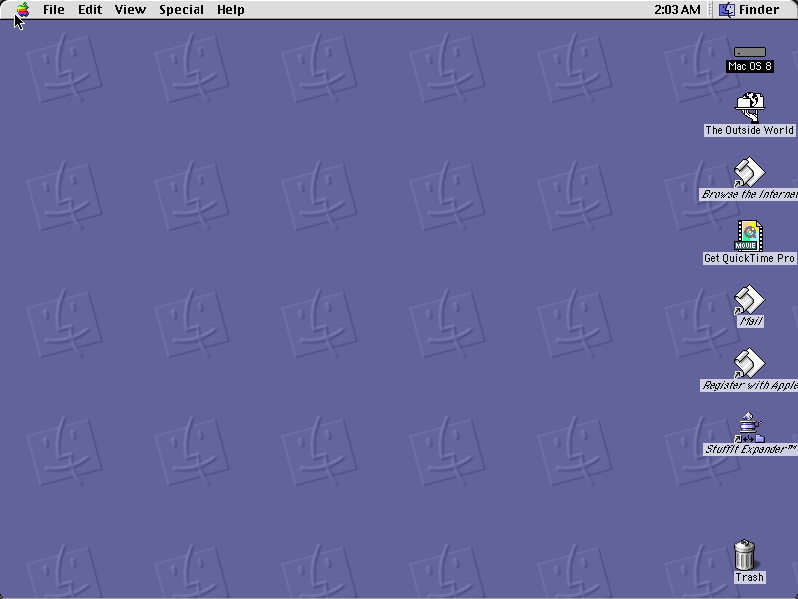
The original floppy carries a MiniFinder alongside the game, and on its own System the machine reaches that launcher rather than the game no matter what the boot blocks say. The application was therefore copied onto a System 7.5.3 disk, which is why a desktop appears for a moment first.
Why it is remembered
"Interactive movie" starts about here. Cinemaware's whole line — Defender of the Crown, Rocket Ranger, It Came from the Desert — was built on the idea that a game could be structured like a film. King of Chicago is the most committed to it.
You play the interior monologue. Selecting from a set of thoughts, some of them contradictory, is a genuinely odd interface and it produces a character who feels less like a puppet than most.
Doug Sharp wrote it in a HyperCard-like system of his own. He has written publicly about the production over the years; it is one of the better-documented pieces of 1980s game development.
Getting started
Let the opening run without touching anything. The game is establishing who everyone is and it will not repeat itself.
When thoughts appear, pick quickly. Hesitating is itself a choice and the scene moves on.
Do not expect to win the first time, or to see the same story twice. Losing the North Side is a normal ending and a different one from the last.
Questions people ask
How do I control it?
By choosing what your character thinks from the options offered during scenes, and by acting on the map screens between them.
Is the story the same every time?
No. It is assembled from scenes rather than following a fixed script, so replays differ substantially.
Is it in colour?
No. This is the 1986 Macintosh release, black and white at 512×342. The Amiga version was in colour.
Why does a desktop appear first?
The floppy carries a MiniFinder that hijacks its own System, so the game is run from a System 7.5.3 disk instead.
Can I save?
Yes. Saves live inside the emulated Macintosh in your browser.
Who made it?
Doug Sharp, published by Cinemaware through Master Designer Software in 1986.