Alter Ego — birth to death, one decision at a time Runs here
1986 · Peter J. Favaro / Activision · System 6 · Mini vMac (Mac Plus) · 512×342 black and white
Guide updated September 2026
You are born, and then you make choices until you die. Alter Ego walks you from infancy through old age in a series of episodes — a fight in the playground, a job offer, a person you could marry — and each one is a branching scene with consequences that carry forward.
Peter Favaro was a developmental psychologist, and the game is built on the actual literature rather than on vibes. Your traits shift according to what you do, and the scenes available later depend on who you have become. It is a strange, earnest thing to find in a 1986 game box.
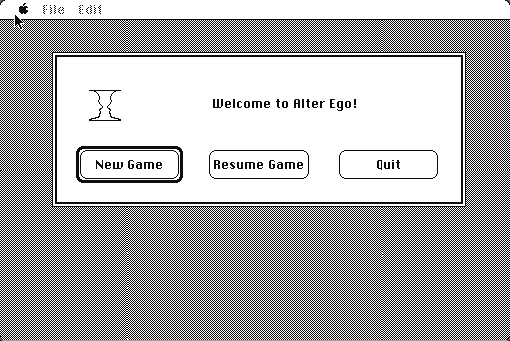
Boots to the opening screen: New Game to be born, or Resume Game to continue a life already in progress.
Controls
| Mouse | Click an episode on the life map, then choose a response |
| Menus | Review your traits, your status, and how the last decision changed them |
Activision published it and still exists. It has not been sold since the 1980s and is part of no current product.
Archives
- Internet Archive — the Macintosh floppy this copy was made from.
How it works & what to expect
| Machine | Macintosh Plus, 512×342, black and white |
|---|---|
| System | The floppy's own — this disk carries the System it shipped with |
| Emulator | Mini vMac, compiled to WebAssembly |
| Saves | Lives save inside the emulated Mac, in your browser |
There is no action here at all. It is a branching narrative with statistics, presented as a map of your life with episodes you choose to enter. A full playthrough takes a few hours and ends when you die, which the game treats matter-of-factly.
The original release came in male and female editions with different content; this is the male edition, which is the one the archive holds.
Why it is remembered
Nothing else was doing this. In 1986 a commercial game about being a person — school, work, illness, marriage, dying — was close to unthinkable, and Activision published it anyway. It sits in histories of the medium as the thing that arrived about twenty years early.
It was researched. Favaro had a doctorate in the field and the trait model reflects real developmental psychology rather than a designer's guesses. Whether that makes it a better game is arguable; it makes it a more interesting one.
It has a real ending. You die, and the game tells you what your life amounted to. Very few games then or now are willing to end that way without softening it.
Getting started
Take New Game and play the childhood episodes in order the first time. The map lets you skip around, but the early choices set the traits everything later depends on.
Read the outcomes rather than skimming them. The game tells you which traits moved and by how much, and that feedback is the only way to understand why later episodes are going the way they are.
Play it twice, differently. A cautious life and a reckless one produce genuinely different games, which is the whole point and is easy to miss on a single run.
Questions people ask
Is there any action?
None at all. It is a branching narrative with a statistical model underneath.
Is this the male or female edition?
The male edition. Activision released two versions with different content; this is the one in the archive.
How long is a playthrough?
A few hours from birth to death, and it is designed to be replayed with different choices.
Can I save?
Yes — lives save inside the emulated Macintosh in your browser.
Who wrote it?
Peter J. Favaro, a developmental psychologist, published by Activision in 1986.
Is it related to the 2010s browser remake?
A free web reimplementation exists and is a different program. This is the original 1986 Macintosh release.