Dark Castle — throwing rocks at bats Runs here
1986 · Silicon Beach Software · System 6 · Mini vMac (Mac SE) · 512×342 black and white
Guide updated September 2026
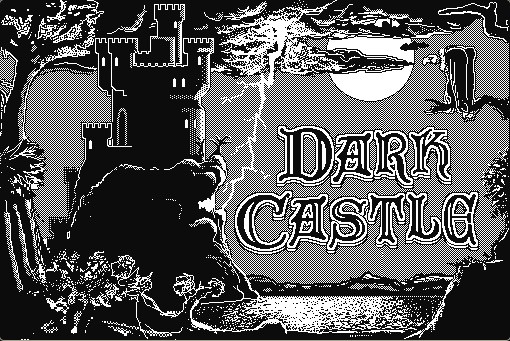
In 1986 the Macintosh was an office machine with a small grey screen, and then Dark Castle arrived: a full-screen black-and-white castle drawn like a woodcut, bats that dive at your head, and rats, and a hunchback throwing rocks down a staircase at you.
It looked like nothing else on any computer, and it sounded like nothing else either. It is still the game people name when they argue the Macintosh was a real games machine.
Boots straight to the Dark Castle title screen on an emulated Macintosh SE. Click through, and start with the Trouble door — it is the easiest of the three.
Controls
| Mouse | Aim, and click to throw a rock |
| A / S / D / W | Run left, crouch, run right, jump — the original key layout |
| Space | Jump |
| Options menu | Difficulty, and remapping the keys if the defaults fight you |
| Cmd-Q | Quit to the Finder |
Silicon Beach Software was bought by Aldus in 1990 and Aldus by Adobe in 1994. Z-Software later made Return to Dark Castle, a new game. The 1986 Macintosh original has not been sold by anyone in nearly forty years. Full reasoning is in notices/dark-castle.md, and the takedown promise applies without argument.
Archives
- Internet Archive — the preserved Macintosh disk this copy came from.
- Macintosh Garden — other releases, Beyond Dark Castle, and documentation.
How it works & what to expect
| Machine | Macintosh SE, 512×342 black and white |
|---|---|
| System | System 7.5.3 |
| Emulator | Mini vMac, compiled to WebAssembly |
| Version | 1.2 |
| Saves | Inside the emulated Mac, in your browser. |
It is hard, and it was meant to be. The controls split between the keyboard and the mouse — you run and jump with your left hand and aim with your right — and that division takes a while to stop feeling wrong. Turn the difficulty down in the Options menu for the first few attempts; the game does not think less of you.
The castle is three doors from the great hall, each leading to a short branch of rooms, and a fourth that opens onto the Black Knight at the end.
Why it looked like that
Mark Stephen Pierce drew it, and he drew it as though the one-bit screen were an engraving rather than a limitation. Everything is cross-hatched, stippled and heavy-lined, and the result has more depth than most colour games of the same year.
The sound is the other half. Dark Castle used digitised audio at a time when nearly every game used beeps — the bats screech, the rocks knock, and your character makes a genuinely upsetting noise when he falls. Silicon Beach recorded that material and shipped it, which is why the game took two floppies when most took one.
The programmer was Jonathan Gay, who was still in his teens. He went on to write the animation tool that became Macromedia Flash, so a reasonable share of the web's first decade traces back to the person who made these bats fly.
Getting anywhere
Throw while moving. Standing still to aim is how you get hit. The mouse aims independently of which way you are running, which is the whole point of the control scheme.
Crouch under things. S drops you low, and a great deal of what is thrown at you passes over a crouching character.
Rocks are limited. You carry a finite number and you will run out. Picking up more is often the real objective of a room.
The Trouble door first. Of the three branches it is the gentlest, and it teaches the movement without the rooms that punish it.
Questions people ask
Is this the original Dark Castle?
Yes — version 1.2 of the 1986 Macintosh release, in black and white, as it shipped. Not Return to Dark Castle and not any of the later console conversions, which look and play quite differently.
Why are the controls split between mouse and keyboard?
Because you aim and move independently. The left hand runs, jumps and crouches; the right hand aims and throws. It is awkward for an hour and then it is the reason the game works.
It is too hard.
Turn the difficulty down in the Options menu, and start with the Trouble door. The game was designed for people who would play it for weeks.
Is the sound really digitised?
Yes, and in 1986 that was remarkable. It is most of why the game shipped on two disks and most of why people remember it.
Who made it?
Silicon Beach Software. Mark Stephen Pierce did the art, Jonathan Gay wrote the code — Gay later created the tool that became Macromedia Flash.
Are saves kept?
Inside the emulated Mac, in your own browser. They survive closing the tab but not clearing site data.