One on One — half court, two legends, one shot clock Runs here
1985 · Eric Hammond / Electronic Arts · System 6 · Mini vMac (Mac Plus) · 512×342 black and white
Guide updated September 2026
Julius Erving at one end, Larry Bird at the other, half a court between them, first to a score you pick. Erving is faster and jumps higher; Bird shoots better from distance and is harder to move off the ball. Playing them as the same character does not work, which was the entire design brief.
It was the first sports game built around two specific, named, licensed athletes who played differently from each other — the thing every sports game does now — and it is where that idea starts.
Boots straight into the game. Pick your player and the match settings, then play.
Controls
| Mouse / keys | Move, shoot, and jump |
| Menus | Choose sides, game length and difficulty |
Electronic Arts owns it and still exists. The game is built on 1983 name-and-likeness licences for two real people, for a product long out of sale; nothing here claims those were renewed. The Macintosh build is in no current product.
Archives
- Internet Archive — the Macintosh floppy this copy was made from.
How it works & what to expect
| Machine | Macintosh Plus, 512×342, black and white |
|---|---|
| System | The floppy's own — this disk carries the System it shipped with |
| Emulator | Mini vMac, compiled to WebAssembly |
| Saves | None; a game is one sitting |
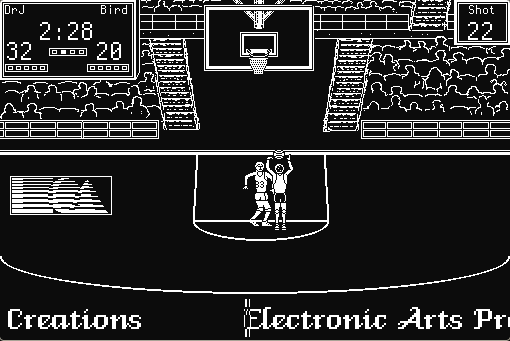
The court is drawn in perspective with the basket at the top, a shot clock and a fatigue bar. The referee turns up for a goaltend, and if you shatter the backboard a janitor comes out to sweep up the glass — a joke that was widely reported at the time and is intact here.
The floppy carries two applications: the game and a small utility called "fooo". This copy names the game as its startup program, so the Macintosh comes up in the match.
Why it is remembered
Licensed athletes who play like themselves. Before this, a sports game's players were interchangeable. Erving and Bird have different speed, different shooting, different stamina, and choosing between them is a real decision. Every sports franchise since has been built on that premise.
The backboard. Dunk hard enough and the glass breaks, the game stops, and a janitor sweeps it up. It is the detail everybody remembers and it is why the game got written about outside the specialist press.
It sold enormously. One on One was among Electronic Arts' biggest early hits and is one of the games that established the company's approach of putting designers' and athletes' names on the box.
Getting started
Play as Erving first. He is quicker and more forgiving, and the drive to the basket is easier to learn than Bird's jump shot.
Watch the fatigue bar. Both players tire, shooting accuracy falls with it, and a game lost in the last minute is almost always a game where you kept sprinting.
On defence, stay between your opponent and the basket rather than chasing the ball. The computer player will happily shoot over a badly positioned defender all day.
Questions people ask
Can two people play?
Yes, on the same machine, which is how it was meant to be played.
Does the backboard really break?
Yes, and a janitor comes out to sweep up. It is the most quoted thing about the game.
Is it in colour?
No. This is the Macintosh version, black and white at 512×342.
Can I save a game?
No. A match is a single sitting.
Why does it not show a desktop?
The floppy names the game as its startup program rather than the Finder.
Is this a licensed game?
It was, in 1983, for both players by name and likeness. Those licences covered a product that stopped being sold decades ago.