The Duel: Test Drive II — F40 against 959, and the police Runs here
1989 · Accolade · System 6 · Mini vMac (Mac Plus) · 512×342 black and white
Guide updated September 2026
Two cars, a Ferrari F40 and a Porsche 959, and a road that is mostly other people's lane. You can race the clock, race the computer, or race a friend on the same machine, and the police will stop you for any of it.
Test Drive II's idea was that the cars should feel like specific cars rather than like a generic racer with different paint. The gearbox matters, the brakes matter, and running the F40 in fourth through a hairpin will put you into the scenery in a way the game clearly enjoys.
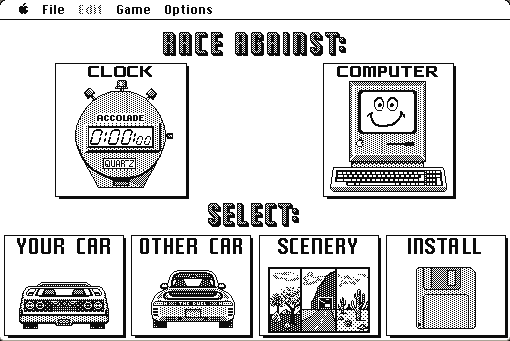
Boots to the selection screen: pick your car, the opponent, the scenery and the transmission, then drive.
Controls
| Arrow keys | Steer, accelerate and brake |
| Number keys | Gears, if you chose the manual gearbox |
| Mouse | The selection screens before a race |
Accolade's catalogue is now with Atari SA, which still exists. The Test Drive brand continues in modern products, none of which contains the 1989 Macintosh build; that build has not been sold in decades.
Archives
- Internet Archive — the Macintosh floppy this copy was made from.
How it works & what to expect
| Machine | Macintosh Plus, 512×342, black and white |
|---|---|
| System | The floppy's own — this disk carries the System it shipped with |
| Emulator | Mini vMac, compiled to WebAssembly |
| Saves | Best times persist inside the emulated Mac |
This is the base game. The scenery and car expansion disks Accolade sold separately — California Challenge, European Challenge, the Supercars and Muscle Cars packs — are not included and were never on this disk.
It is black and white and the framerate is what a 68000 managed in 1989, which is to say the road arrives in chunks. That is the authentic article rather than an emulation problem.
Why it is remembered
The cars were the point. Test Drive I established the formula; the sequel made the handling models distinct enough that choosing between the F40 and the 959 was a real decision. That idea — licensed cars that drive differently — became the entire driving-game genre.
The police. Being pulled over for speeding in a racing game was novel and slightly absurd, and it is the detail people bring up first.
It was modular. Selling scenery and cars as add-on disks was unusual in 1989 and is a recognisable ancestor of how driving games are sold now.
Getting started
Take the automatic gearbox for your first few runs. The manual is more satisfying and much slower to learn, and the roads punish you while you are learning it.
Brake before the corner, not in it. The handling model is unforgiving about weight transfer and the most common crash is a mid-corner brake on a downhill.
The police are avoidable if you watch for them and lift early. Getting stopped costs more time than driving the whole section carefully would have.
Questions people ask
Are the expansion disks included?
No. California Challenge, European Challenge and the car packs were sold separately and are not part of this disk.
Can two people play?
Yes — the two-player mode alternates on the same machine, which is how it was played in 1989.
Is it in colour?
No. This is the Macintosh release, black and white at 512×342.
Why is it choppy?
That is the original framerate on a 68000. The emulator runs the machine at its real speed rather than smoothing anything over.
Manual or automatic?
Both are offered on the selection screen. Automatic is much easier to start with; manual is faster once you know the roads.
Is this related to Test Drive Unlimited?
Same brand, different company era, entirely different software. Nothing sold today contains this program.