Crystal Quest — collect, escape, repeat Runs here
1987 · Casady & Greene · System 7 · Mini vMac (Mac II) · 640×480 at 8-bit colour
Guide updated September 2026
Gather the crystals, then fly to the exit. Do it while an increasing number of things that want to kill you fill the screen and learn your habits. There is no more to it than that, and Crystal Quest was one of the most-played Macintosh games ever released.
It is controlled entirely with the mouse, which sounds like a compromise and is in fact the reason it feels so good.
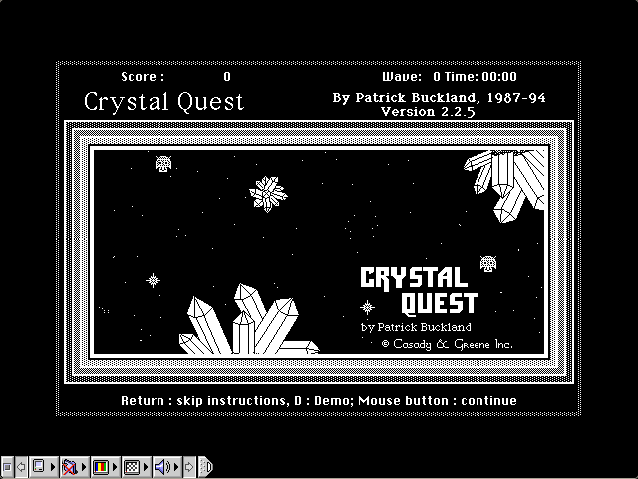
Boots to the Crystal Quest title screen on an emulated Macintosh II. Click to continue, and move with the mouse — your ship goes where you point.
Controls
| Mouse | Fly. The ship follows the pointer directly. |
| Mouse button | Fire, in the direction you are moving |
| Return | Skip the instructions at the title screen |
| D | Watch the demo |
| Cmd-Q | Quit to the Finder |
Casady & Greene closed in 2003. A Crystal Quest remake appeared on Xbox Live Arcade in 2007, made by other people; it is a different program. This Macintosh original has not been sold in over twenty years. Full reasoning is in notices/crystal-quest.md, and the takedown promise applies without argument.
Archives
- Internet Archive — the preserved Macintosh disk this copy came from.
- Macintosh Garden — other releases, Crystal Crazy, and documentation.
How it works & what to expect
| Machine | Macintosh II, 640×480 colour |
|---|---|
| System | System 7.5.3 |
| Emulator | Mini vMac, compiled to WebAssembly |
| Version | 2.2.5 |
| Saves | High scores live inside the emulated Mac, in your browser. |
Each wave drops a field of crystals and a set of enemies. Collect every crystal and the gate at the edge of the screen opens; fly through it and the next wave starts, harder.
The mouse control is absolute rather than relative — the ship is where the pointer is — so you can cross the screen instantly if your hand can move that fast. That is the skill ceiling, and it is high.
The nasties
Enemies arrive by type and each behaves differently, which is the whole strategic layer. Some drift. Some home in. Some sit still and shoot. Some split when you kill them, and killing them at the wrong moment is worse than leaving them alone.
Mines are the ones that get you. They do not chase — they simply sit in the path between you and the last crystal, and the game is very good at placing them where you were about to go.
There is a bonus for finishing a wave quickly and a bigger one for not firing at all, which turns some waves into a pure evasion puzzle. Playing for score and playing to survive are genuinely different games.
The voices
Crystal Quest talks. It congratulates you, it insults you when you die, and the sampled voices — recorded by the developers, including a deadpan "ooooh" and a resigned "that's nice" — are the thing every person who played it remembers first.
Patrick Buckland wrote the game; Casady & Greene, a Mac-only publisher with an unusually good ear for what the platform's users wanted, published it. Buckland later founded Rockstar Leeds. Casady & Greene closed in 2003, a Macintosh software house that outlived nearly all the others and is now mostly remembered for this and for Conflict Catcher.
The sound files are still on the disk with their copyright notices in the filenames, which is a small and rather charming piece of 1994 housekeeping.
Questions people ask
Is this the original Crystal Quest?
It is version 2.2.5, the Macintosh release by Casady & Greene. Not the 2007 Xbox Live Arcade remake, which is a different program by different people.
How do I control it?
With the mouse alone. The ship goes exactly where you point, and the button fires in whatever direction you are moving.
Why can I not use the keyboard?
The game was designed around the mouse, and the absolute positioning is the point — you can cross the screen as fast as your hand moves, which no keyboard would allow.
How do I score well?
Finish waves quickly, and finish them without firing where you can. The no-shot bonus is large enough that some waves are best played as pure evasion.
Does it really talk?
Yes. The sampled voices are the first thing most people remember about it, and the sound files are still sitting on the disk with their 1994 copyright notices in the filenames.
Are high scores kept?
Inside the emulated Mac, in your own browser. They survive closing the tab but not clearing site data.