Seven Cities of Gold — a whole continent, and no map Runs here
1985 · Ozark Softscape / Electronic Arts · System 6 · Mini vMac (Mac Plus) · 512×342 black and white
Guide updated September 2026
You take a commission from the Spanish crown, fit out some ships, sail west and find out what is there. The coastline is drawn as you sail along it. The interior is blank until you walk into it. When you meet people, you can trade with them, ask them for guides, or attack them, and the game keeps score of all three without ever telling you which it approves of.
The map can be the real Americas or one the game invents, which in 1984 was an unusual thing for a program to offer and is still the feature people mention first. Playing the random map strips away everything you already know and leaves the actual game: you have limited food, a crew whose morale you can lose, and a king who expects gold.
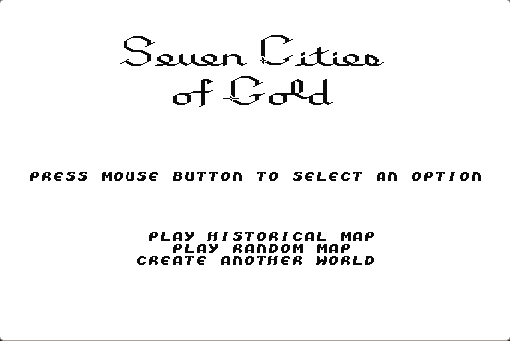
Boots straight into the game. Choose the historical map, a random map, or generate a new world of your own.
Controls
| Mouse | Move your expedition and choose menu options |
| At sea | Follow the coast to chart it; open water costs food and time |
| On meeting a village | Trade, seek guides, seek gold, or attack |
| Menus | Report to the crown, manage the expedition, save |
Electronic Arts owns it and still exists. The 1985 Macintosh build has never been re-released; the 1993 Commemorative Edition was a different program and is itself out of print. Hosted as an out-of-commerce artefact, not an ownerless one.
Archives
- Internet Archive — the Macintosh floppy this copy was made from.
How it works & what to expect
| Machine | Macintosh Plus, 512×342, black and white |
|---|---|
| System | The floppy's own — this disk carries the System it shipped with |
| Emulator | Mini vMac, compiled to WebAssembly |
| Saves | Inside the emulated Mac, in your browser |
The opening menu offers a historical map, a random map, or world generation. The generator is the reason to come back: it builds a continent, populates it, and does not tell you what is on it.
The Macintosh version is black and white and slower than the eight-bit originals, and the interface is mouse-driven rather than joystick-driven, which suits it. Expeditions are a matter of clicking carefully rather than reacting.
Why it is remembered
Procedural generation, in 1984, as the selling point. Not a random dungeon — a continent, with coastlines, rivers, terrain and settlements, generated so that the exploration loop still worked. It is one of the earliest commercial games built around the idea.
It does not editorialise, and that is uncomfortable. Massacring a village is a button. It is often profitable and the game reports it without comment. Bunten said the intent was to let the player find out what they would do, and modern writing about the game spends most of its time on exactly that.
Dan Bunten's design reputation starts here. Later known as Danielle Bunten Berry and best remembered for M.U.L.E., Bunten made Seven Cities the commercial success that M.U.L.E. was not.
Getting started
Take the historical map first so the geography is at least familiar, then switch to a generated world once you know the controls.
Chart the coast before you go inland. Coastline is cheap to map from a ship and it tells you where the rivers come out, which is where the settlements are.
Food and crew morale are the two things that end expeditions. Trade for food early and often, take guides when offered, and go home before you have to — a modest haul delivered is worth more than a large one that never reaches Spain.
Questions people ask
Is the map always the Americas?
No. You can play the historical map, a random map, or have the game generate a whole new world. The generator is the feature the game is remembered for.
Is this the Commemorative Edition?
No. This is the original 1985 Macintosh release. The 1993 Commemorative Edition is a different, later program.
Can I attack the people I meet?
Yes, and the game neither stops you nor comments on it. That the choice is offered plainly is deliberate on the designer's part.
Can I save?
Yes. Saves live inside the emulated Macintosh in your browser.
Is it black and white?
Yes — the Macintosh of 1985 was. The colour version people remember is the Commodore 64, Atari or Apple II release.
Who made it?
Ozark Softscape, led by Dan Bunten, published by Electronic Arts. Bunten later transitioned and was known as Danielle Bunten Berry.