Balance of Power — you do not win, you avoid losing Runs here
1985 · Chris Crawford / Mindscape · System 6 · Mini vMac (Mac Plus) · 512×342 black and white
Guide updated September 2026
You are the United States or the Soviet Union, from 1986 to 1994, and your job is to accumulate prestige without starting a nuclear war. You send aid, you back insurgencies, you apply diplomatic pressure, and every one of those moves can be challenged by the other side. Back down and you lose prestige. Do not back down and the crisis escalates a step.
The famous part is what happens if you push one too far. The game ends, and it refuses to dramatise it: no mushroom cloud, no animation, just a line of text telling you that you have lost and that there is no scoring in a nuclear war. Crawford put it there deliberately and it is the single most quoted screen in 1980s computer gaming.
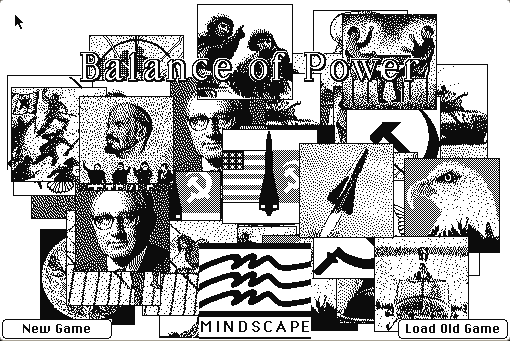
Boots straight into the game. Choose New Game, pick a superpower and a difficulty level, and the world map is the interface.
Controls
| Mouse | Click a country on the map to act on it |
| Menus | Policies, briefings, and the eight kinds of information the game keeps about every country |
| Next Turn | End your year and see what the other side did |
Mindscape published it and its assets were dispersed after the company wound down. The Macintosh build has not been sold by anyone since the 1980s. Chris Crawford has released material for some of his other games publicly; no permission from him is claimed for this one.
Archives
- Internet Archive — the Macintosh floppy this copy was made from.
How it works & what to expect
| Machine | Macintosh Plus, 512×342, black and white |
|---|---|
| System | The floppy's own — this disk carries the System it shipped with |
| Emulator | Mini vMac, compiled to WebAssembly |
| Saves | Inside the emulated Mac, in your browser |
This is a game of menus and a world map, and it does not explain itself gently. Every country has records for its government, its insurgency, its finances and its relations with both superpowers, and reading those is most of the game.
The application is named "Balance of Power" on the original floppy. The boot blocks that name a disk's startup program hold fifteen characters, so on this copy the file is called "Balance of Powe" — nothing else was altered, and you never see a Finder in which the shortened name would appear.
Why it is remembered
It took a position. Crawford was not making a wargame with a Cold War skin; he was arguing that the superpower relationship was a system with rules, and that the rules made brinkmanship a losing strategy. You can disagree with the thesis — plenty did — but the game is genuinely about something.
The losing screen. "You have just lost the game. However, there is no animated display of a mushroom cloud with parts of bodies flying through the air. We do not reward failure." It has been quoted, argued about and imitated for forty years.
It sold like a real game. Around a quarter of a million copies, with a companion book from Random House. A political simulation with no combat was, briefly, a mainstream hit.
Getting started
Play the United States on the lowest difficulty first, and spend the first year doing nothing but reading. Open a few countries and look at what the game tracks about them; the interface is dense and the vocabulary is its own.
Prestige comes from having friendly governments in countries that matter. Small aid to a country nobody is contesting is cheap and safe; backing a coup in a country the other side cares about is where crises come from.
When the other side challenges you, the question is always the same: is this worth a step up the escalation ladder? Most of the time it is not. Learning to fold early, repeatedly, and still finish ahead on prestige is the whole skill of the game.
Questions people ask
Is this the 1990 edition?
No. This is the original 1985 Macintosh Balance of Power. The 1990 edition is a later, larger game and is not here.
Can I win?
You can finish 1994 with more prestige than the other side, which is the win. The design is arranged so that aggressive play tends to end the game early and badly.
Does it really refuse to show the war?
Yes. The nuclear-war ending is a paragraph of text that explicitly declines to dramatise it, and it is intact in this copy.
Can I save?
Yes. Saves live inside the emulated Macintosh in your browser.
Is there a tutorial?
Not really. The game shipped with a substantial manual which is not on the disk; expect to spend your first game learning the interface.
Why is it black and white?
The Macintosh of 1985 was. This is the original release, not a later colour port.