Domain — claim the grid before the computer does Runs here
1996 · Mike Perry · Mac OS 8 · SheepShaver (Power Macintosh 9500) · 800×600 at 8-bit colour
Guide updated September 2026
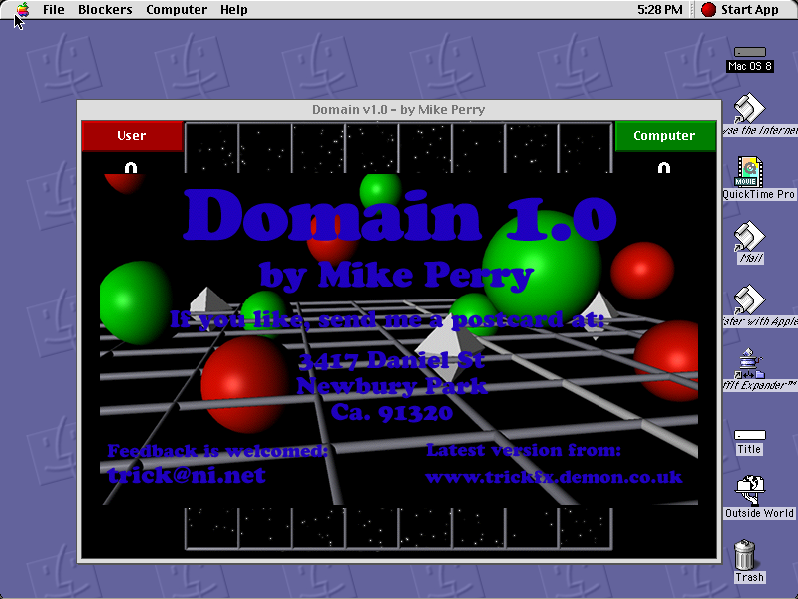
A grid of nodes in three dimensions, spheres in two colours, and a computer opponent taking territory at the same time you are. Domain is a spatial strategy game with a short rule set and a lot of room to be wrong about what you are looking at.
The presentation is the striking part: rendered spheres on a wireframe lattice, in colour, on a game one person wrote and put out as shareware in 1996. It looks like something with a budget.
Boots Mac OS 8.6 and opens Domain on its title screen. Choose User or Computer for each side and start.
Controls
| Mouse | Click a node to claim it |
| Computer menu | Set which sides the computer plays and how well |
| Blockers menu | Board variations |
| Cmd-Q | Quit to the Finder |
Shareware, distributed freely by its author. The copy here is unregistered and unmodified, with the registration notice and documentation intact.
Archives
- Internet Archive — the Tucows Macintosh archive copy this was built from.
How it works & what to expect
| Machine | Power Macintosh 9500, 800×600 in colour |
|---|---|
| System | Mac OS 8.6, shared with every other title of this era |
| Emulator | SheepShaver, compiled to WebAssembly |
| Version | 1.0 |
| Saves | Settings persist inside the emulated Mac |
Domain does not carry its own operating system — Mac OS 8.6 comes from the shared image used by the other Mac OS 8 titles here, so it starts much faster if you have opened one of those already.
The rules are not explained on screen. The read-me that came with it is on the disk and is worth opening before your first game.
Why it is remembered
It is a one-person game that looks like a product. Rendered 3D artwork on a shareware strategy game in 1996 was not common, and Domain's presentation is the reason it stood out on the shareware shelves.
Spatial reasoning in three dimensions is genuinely hard. The rules would be trivial on a flat board. On a lattice you keep missing connections that are obvious once someone points at them, which is the whole game.
Mac shareware culture. Domain is a good representative of the enormous middle of that scene: not famous, competently made, distributed through Info-Mac and the CD-ROM collections, and preserved now only because Tucows' archive was kept.
Getting started
Read the documentation on the disk first. The rules are short and the game does not explain them.
Play the computer at the easiest setting for one game and pay attention to which nodes it takes. Its opening preferences are a decent guide to what matters.
Rotate your attention rather than the board: the trap is reasoning about the face you are looking at and forgetting the connections going into the screen.
Questions people ask
Is it free?
It is shareware — freely distributed and fully playable, with the author's registration notice intact.
Where are the rules?
In the documentation on the disk. The game does not explain itself on screen.
Can two people play?
Yes — set both sides to User from the Computer menu.
Why does it take a while to start?
It boots Mac OS 8.6 first. That image is shared with the other Mac OS 8 titles, so it is much faster the second time.
Is it in colour?
Yes, 800×600 on an emulated Power Macintosh.
Who wrote it?
Mike Perry, and released as Macintosh shareware in 1996.