Arashi — Tempest, rebuilt for the Macintosh Freely distributable
1993 · Juri Munkki and Mike Kelly · System 7 · Mini vMac (Mac II) · 640×480 at 8-bit colour
Guide updated September 2026
Atari's Tempest put you on the rim of a tube and threw things up it at you. Arashi does the same, on a Macintosh, in 1993, with colour, a soundtrack and a level compiler its authors wrote so the game could be scripted. It is faster and stranger than the original, and it has the particular quality a lot of the best Mac shareware has: someone built it because they wanted it to exist.
It boots straight into the game here. The name is Japanese for storm.
Boots straight into Arashi's options panel. Click Start Game — or set the difficulty first.
Controls
| Mouse | Move around the rim — this is a mouse game first |
| Click | Fire |
| Space | Superzapper, when you have one |
| Esc | Pause and the menu |
| Cmd-Q | Quit to the Finder |
Arashi's ReadMe, which is on the disk you are booting, says it plainly: "ARASHI is freely distributable as long as it is not for profit." Nothing here is modified and this site carries no advertising, so both halves of that hold. The authors also included the C source, which is on the disk as they shipped it. Full provenance is in notices/arashi.md.
Get a copy
- MacSilverWare at the Internet Archive — the shareware CD this copy came from, under Games:Arcade.
How it works & what to expect
| Machine | Macintosh IIfx, 32 MB RAM, 640×480 |
|---|---|
| System | System 7.5.3 |
| Emulator | Basilisk II, compiled to WebAssembly |
| Version | Arashi 1.1, June 1993 — the release with the scripting engine |
| Sound | Yes. Click once inside the screen first; browsers block audio until you do. |
| Mobile | It runs, but this is a mouse game and a touchscreen is a poor substitute. |
Arashi needs 256 colours, which the emulated machine has. The game takes a moment to build its first level after the splash screen.
What it added to Tempest
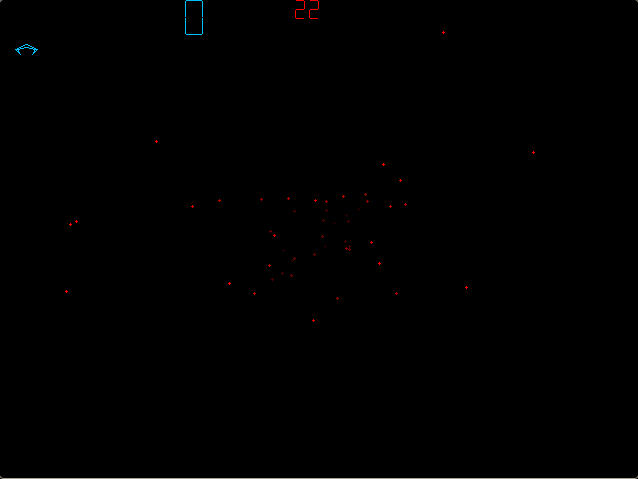
The shape is familiar: you run around the edge of a well, firing down it, while things climb up towards you. Let one reach the rim and it comes for you along it.
What Arashi adds is a decade of hardware. The wells are drawn in colour with proper shading rather than vectors. There is a soundtrack. There are power-ups, a save system, and what the ReadMe calls doomsday levels — the difficulty past the point where the game stops being reasonable.
The most interesting addition is invisible while you play. Juri Munkki wrote a game compiler and scripting language for the 1.1 release, so the levels are data rather than code. That is why the C source shipped alongside the game: the authors expected people to look.
Mac shareware as a culture
Arashi is a good example of a category that barely exists now. Two people wrote an arcade game to a standard that would have been commercial a few years earlier, put it on the Info-Mac archive, asked for nothing, and included the source.
The distribution model made that normal. A shareware author had no publisher, no shelf space and no marketing, so the software had to travel by being copied — which meant the licence had to permit copying, and most of them did, in a sentence written by the author rather than a lawyer. Arashi's is one line long.
That is why a site like this can exist at all. A large part of the Macintosh catalogue between 1985 and 2000 was released on terms that explicitly allow what you are doing right now.
Questions people ask
Is Arashi free?
Yes, on its authors' own terms. The ReadMe on the disk says it is freely distributable as long as it is not for profit. It is not a demo or a crippled version — this is the whole game.
Is this just Tempest?
It takes Tempest's shape and builds on it: colour, a soundtrack, power-ups, saved games, a scripting engine for the levels, and difficulty settings past anything the original attempted. Whether that makes it a clone or a successor is a matter of taste.
Do I need a mouse?
Effectively yes. Arashi is played by moving around the rim of the well, and it maps that to the mouse. A trackpad works; a touchscreen is a struggle.
What does the name mean?
Storm, in Japanese. The game was called something else for version 1.0 and the ReadMe notes the change in its first paragraph.
Is the source code really included?
It is, in a folder on the disk you are booting. The authors shipped it with the game and it has been left exactly where they put it.
Who wrote it?
Juri Munkki and Mike Kelly, released in June 1993. Munkki wrote the game compiler and scripting language for this version.