Chiral — bond the atoms before the lab fills Runs here
1994 · Ambrosia Software · Mac OS 8 · SheepShaver (Power Macintosh 9500) · 800×600 at 8-bit colour
Guide updated September 2026
A laboratory has built a machine that makes atoms out of thin air and cannot switch it off. Your job is to bond the unstable atoms it produces into stable molecules before they fill the screen. Chiral's own FAQ calls it a fusion of atomic bonding and the addictive play of Tetris.
It was written by Trevor Powell and Andrew Welch, Ambrosia's founder, and first released in 1994. This is version 1.0.4.
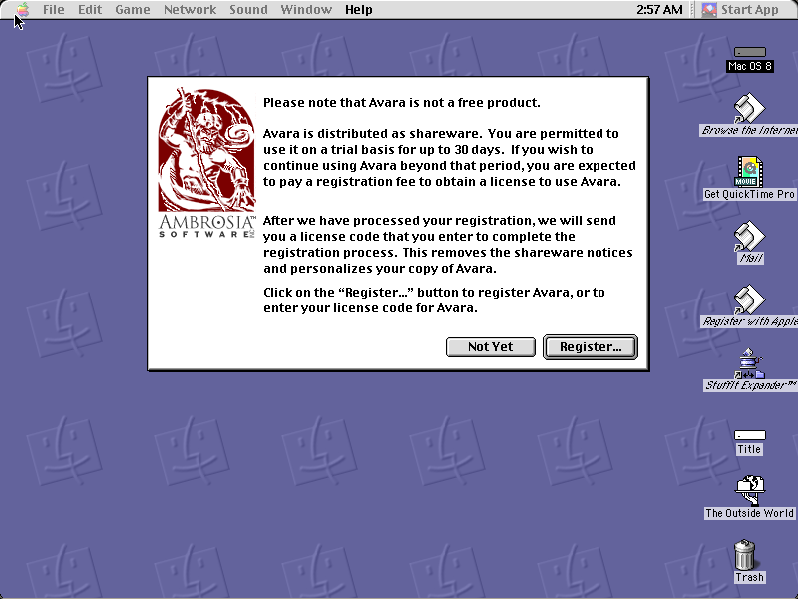
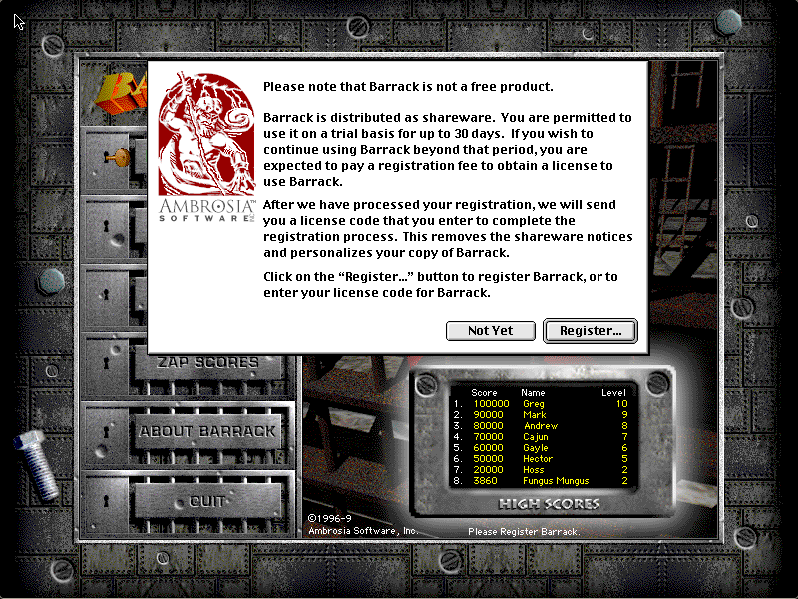
Boots Mac OS 8.6 and opens Chiral by itself. Click through the title, wait for Not Yet to light up on the shareware notice and click it, then click the small button beside Play Chiral.
Controls
| Mouse | The menu buttons are the small flags beside each label |
| Instructions | The game's own guide to bonding atoms, from the menu |
| Cmd-Q | Quit to the Finder |
Chiral is Ambrosia Software shareware. Its licence permits non-profit distribution provided the software is unmodified and the complete works are included, and both are true here. The copy is unregistered, and the shareware notice it shows at startup is left in place. Full reasoning is in notices/chiral.md.
Archives
- Internet Archive: the Ambrosia installer this copy was produced from, via the Tucows Mac archive.
How it works & what to expect
| Machine | Power Macintosh, 800×600, 256 colours |
|---|---|
| System | Mac OS 8.6 |
| Emulator | SheepShaver, compiled to WebAssembly |
| Version | Chiral 1.0.4 (April 1996; first released April 1994) |
| Saves | Inside the emulated Mac, in your browser |
The first start is the slow one: Mac OS 8.6 downloads once and every Mac OS 8 title after it starts much faster. Chiral is light: its FAQ asks for a 256-colour screen and 1.5 MB of memory.
The game
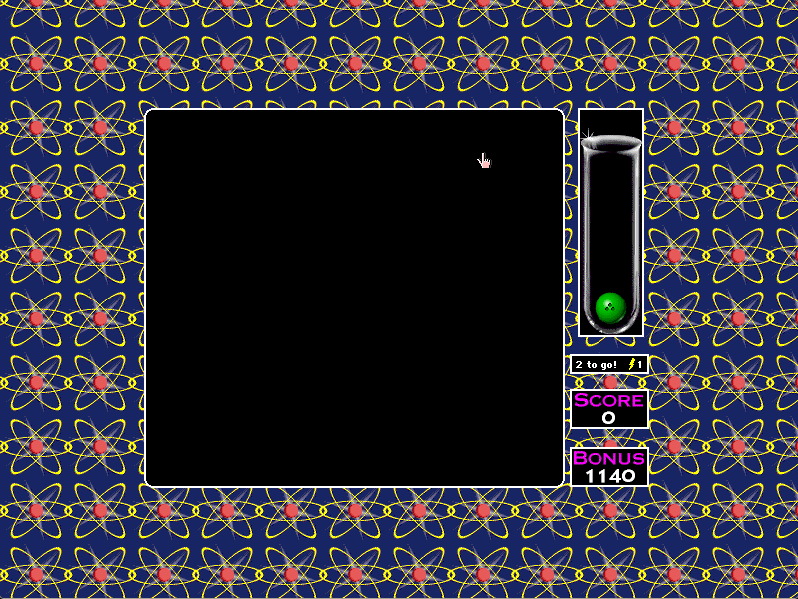
The machine keeps producing unstable atoms, and the job is to bond them into stable molecules before they take over. Beside the board sit a test tube with an atom in it, your score and a bonus.
The FAQ counts six difficulty settings and twenty-four levels, 144 screens in all. The menu sets difficulty, sound volume and music, and keeps a high-score table. The clickable parts of the menu are the small flag buttons beside each label, not the words, which is worth knowing before you wonder why nothing happens.
Ambrosia's early catalogue
Chiral is from the first years of Ambrosia Software, the Rochester shareware house Andrew Welch founded, which also published Maelstrom. The in-game credits still read ©1994–6.
Questions people ask
How do I start?
Click past the title, click Not Yet on the shareware notice once it lights up, then the small button beside Play Chiral.
Why does clicking Play Chiral do nothing?
The buttons are the little flag icons to the left of each label. Click the flag, not the word.
Is it like Tetris?
Its own FAQ describes it as atomic bonding crossed with Tetris-style play: things arrive, you fit them together, and you lose when the space runs out.
Is it legal to play here?
Chiral is Ambrosia shareware, and its licence allows non-profit distribution as long as the software is unmodified and complete. This site is non-profit and carries no advertising.
Are high scores kept?
Inside the emulated Mac, in your own browser.
Put Chiral on your own site
Free, no permission needed and no account. Paste this where you want the machine to appear; it brings its own emulator and asks nothing of your page.
<iframe src="https://macemu.com/embed/chiral/"
        width="800" height="600"
        style="border:0;max-width:100%"
        allowfullscreen
        title="Chiral"></iframe>
Sized to this title's real screen. How embedding works.