Hacker — LOGON PLEASE, and nothing else Runs here
1985 · Steve Cartwright / Activision · System 6 · Mini vMac (Mac Plus) · 512×342 black and white
Guide updated September 2026
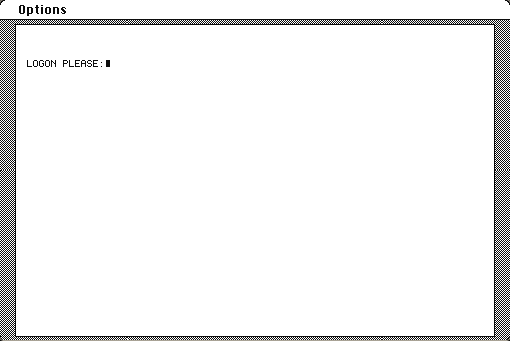
The screen says LOGON PLEASE and waits. There is no title, no menu, no help, and the manual that came in the box told you almost nothing either — Activision's marketing line was that you had dialled into something by accident.
What you do about that is the game. Getting past the prompt is the first puzzle and it is meant to look impossible; the whole design is a bluff about the player having stumbled somewhere they should not be, and it holds up surprisingly well precisely because nothing on screen is trying to help you.
Boots straight to the logon prompt. There are no instructions, deliberately. Type and see what happens.
Controls
| Keyboard | Type at the prompt. That is the entire interface at first. |
| Mouse | Used later, once the game has shown you what it is |
Activision published it and still exists. Hacker has not been sold since the 1980s except on long out-of-print compilations, and is in no current product.
Archives
- Internet Archive — the Macintosh floppy this copy was made from.
How it works & what to expect
| Machine | Macintosh Plus, 512×342, black and white |
|---|---|
| System | The floppy's own — this disk carries the System it shipped with |
| Emulator | Mini vMac, compiled to WebAssembly |
| Saves | None. Hacker is meant to be played in one sitting. |
Be patient at the prompt. The game expects you to fail at the logon and it is watching how you fail; several wrong attempts are part of the script, not a dead end.
Once you are through, it becomes something else entirely, and saying what would spoil the only surprise the game has. It is short — an hour or two if things go well — and it is designed to be replayed once you know the shape of it.
Why it is remembered
It shipped with no instructions on purpose. The box was nearly empty. In an era when games came with forty-page manuals and a map, Activision sold one whose entire pitch was that you would have to work out what it was. Very little since has been willing to do that.
It caught a moment. 1985 was the year WarGames was still recent and modems were exotic. Hacker is what a mainstream audience thought computer intrusion looked like, preserved exactly.
Steve Cartwright came from Atari 2600 games. Barnstorming, Megamania, Frostbite — arcade titles with no narrative at all. Hacker is the sharp turn, and it worked well enough to get a sequel the following year.
Getting started
Try to log on. Try again. Keep going — the failure is scripted and something happens after enough of them.
When the game opens up, write things down. It hands you information in pieces and expects you to hold them; there is no journal and no map, and the second half is much harder if you are relying on memory.
There is no save. If you lose, you start over, which is less punishing than it sounds because the opening goes quickly once you know it.
Questions people ask
Is there really no tutorial?
None, and that is the design. The original box shipped with almost no documentation as a deliberate marketing decision.
Am I supposed to fail the logon?
Yes. Repeated failure is part of the opening script. Keep trying.
How long is it?
An hour or two once you are through the opening, and it is built to be replayed.
Can I save?
No. Hacker has no save function on any platform.
Is there a sequel?
Hacker II: The Doomsday Papers, from 1986. It is not on this site: the copy that survives still demands its original disk on startup, so there is nothing playable to host.
Who wrote it?
Steve Cartwright, previously known for Atari 2600 games including Barnstorming and Frostbite.