The Crimson Crown — and two companions who can go where you cannot Runs here
1985 · Penguin Software · System 6 · Mini vMac (Mac Plus) · 512×342 black and white
Guide updated September 2026
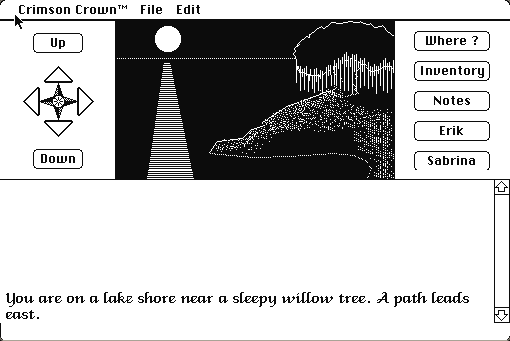
The sequel to Transylvania, and a notably better game than it. You have two companions — Erik and Sabrina — and you can send either of them off independently, which means puzzles that need two people in two places at once, an unusual thing for 1985.
The screen puts a picture window in the middle, a compass on the left, and a row of buttons on the right for Where?, Inventory, Notes and each companion. The prose window runs underneath. It is a clean layout and it makes the game much less tiring to sit with than most of its contemporaries.
Boots straight into the game on a lake shore. Use the compass to move and the side buttons to switch character.
Controls
| Compass | Move in eight directions plus up and down |
| Erik / Sabrina buttons | Switch to a companion and act as them |
| Where? / Inventory / Notes | Location, what you carry, and the game's own journal |
| Type + Return | Anything the buttons do not cover |
Penguin Software became Polarware and wound down in the early 1990s. This Macintosh build has not been sold in decades and is in no current product.
Archives
- Internet Archive — the Macintosh floppy this copy was made from.
How it works & what to expect
| Machine | Macintosh Plus, 512×342, black and white |
|---|---|
| System | The floppy's own — this disk carries the System it shipped with |
| Emulator | Mini vMac, compiled to WebAssembly |
| Saves | Inside the emulated Mac, in your browser |
The Notes button is a genuine journal that the game writes for you, which was a thoughtful thing to include and is the sort of detail Penguin's Macintosh games did well.
Switching characters is not cosmetic. Erik and Sabrina go to different places and can do different things, and several puzzles cannot be solved without moving between them.
Why it is remembered
Three characters, independently controlled. That is a structural idea, not a feature, and almost nothing else in 1985 was attempting it in an adventure game.
It is the good Transylvania game. Transylvania is the better-known title and the more primitive one. The Crimson Crown is where Penguin worked out what the engine could do.
Penguin's Macintosh interface work. Compass, inventory, journal and character switching as buttons, with the parser as a fallback rather than the whole interface — that is close to how graphic adventures would work for the next decade.
Getting started
Try all three characters early. Walk each of them somewhere and see what they can reach; the shape of the game becomes obvious once you have.
Check Notes regularly. The game records things for you and it is easy to forget it is doing so.
When you are stuck, the answer is often that the wrong character is standing in the right place. Switch before you go looking for an object.
Questions people ask
Do I need to have played Transylvania?
No. It is a sequel but stands on its own, and it is the better game of the two.
Can I really control three characters?
Yes — yourself, Erik and Sabrina, switched from the buttons on the right. Several puzzles require it.
Is there a journal?
Yes. The Notes button shows a record the game keeps for you as you play.
Can I save?
Yes. Saves live inside the emulated Macintosh in your browser.
Does it need typing?
Less than most. The compass and buttons cover movement and common actions; the parser handles the rest.
Who made it?
Penguin Software, later Polarware, who also published Pensate and The Quest for the Macintosh.