Math Blaster — the original one Runs here
1986 · Davidson & Associates · System 6 · Mini vMac (Mac SE) · 512×342 black and white
Guide updated September 2026
Jan Davidson was a teacher who could not find software she wanted to use with her students, so she wrote some. Math Blaster was the result, and it sold well enough to build a company that defined educational software for a decade.
This is the Macintosh release, and it is more than a drill: six topics from addition to percentages, five difficulty levels each, an editor for putting in your own problems, and a rocket game at the end that is the reason anyone remembers it.
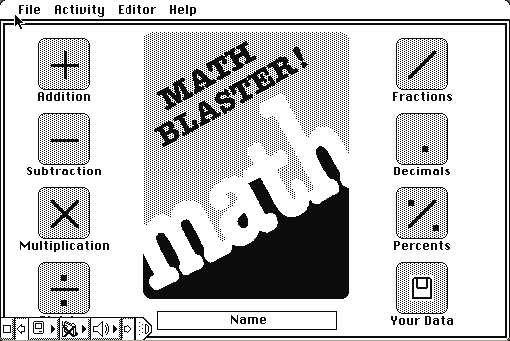
Boots straight into Math Blaster on an emulated Macintosh SE. Pick a topic from the icons, choose a level, and work through it.
Controls
| Mouse | Choose a topic, a level and an activity |
| Number keys | Type answers |
| Return | Submit an answer |
| Arrow keys / Space | Fly and fire in the Blaster game |
| Cmd-Q | Quit to the Finder |
Davidson & Associates was bought by CUC International in 1996, became part of Knowledge Adventure, and Math Blaster products are still sold under that name today. Those are new software. This 1986 Macintosh build has not been sold by anyone in nearly forty years. Full reasoning is in notices/math-blaster.md, and the takedown promise applies without argument.
Archives
- Internet Archive — the preserved Macintosh floppy this copy came from.
- Macintosh Garden — other releases and documentation.
How it works & what to expect
| Machine | Macintosh SE, 512×342 black and white |
|---|---|
| System | System 7.5.3 |
| Emulator | Mini vMac, compiled to WebAssembly |
| Version | 1.0, the Macintosh release |
| Saves | Inside the emulated Mac, in your browser. Do not keep anything irreplaceable there. |
The opening screen is the whole program: six subject icons — addition, subtraction, multiplication, division, fractions, decimals and percentages — plus "Your Data", which is where progress is recorded. Each subject has five levels, and the levels are real levels, not cosmetic ones.
The original shipped with saved records for three children named Zachary, Lou Anne and Jeremy, and they are still on the disk here. They belonged to whoever owned this copy in the 1980s.
The four activities, and the rocket
Each topic offers the same four ways in. Look and Learn shows worked examples. Build-a-Problem has you assemble the problem rather than only answer it, which catches the children who can compute but cannot read a question. Solve the Problem is straight drill against the clock.
And then Math Blaster, which is the arcade game: answers drift past on a rocket, you fly to the right one and fire. It is not sophisticated — it is a shooting gallery with sums in it — but it is the part every ten-year-old played for, and the part that made the drill tolerable.
The design underneath is the interesting bit. The game does not make the maths easier when you struggle; it makes the presentation change. That was an unusual idea in 1986 and it is the reason the series lasted.
Where this came from
Jan Davidson taught, tutored, and in 1982 started writing software on an Apple II at her kitchen table. She and her husband Bob sold the early programs themselves, mailing disks out of the house. Math Blaster was the one that broke through.
By the early 1990s Davidson & Associates was one of the largest educational software publishers in the United States, and it was sold in 1996 for around a billion dollars. Reading Blaster, Science Blaster and a long line of sequels followed, and Math Blaster games are still made today.
The 1986 Macintosh original is a much smaller thing than any of them: one screen, six topics, a rocket, and an editor so that a teacher could put in their own problems. It is also, unmistakably, software written by somebody who had actually taught.
Questions people ask
Is this the original Math Blaster?
It is the 1986 Macintosh release of it — the first generation, in black and white, before the series became Blaster Learning System and everything after.
What can it teach?
Addition, subtraction, multiplication, division, fractions, decimals and percentages, at five levels each.
Who are Zachary, Lou Anne and Jeremy?
Saved student records that were on this disk when it was preserved. They belonged to whoever owned the copy in the 1980s, and they have been left where they were.
Can I add my own problems?
Yes — the Editor menu lets you build problem sets, which is how it was meant to be used in a classroom. They save into the emulated Mac, which lives in your browser.
Where is the rocket game?
Pick a topic and a level, then choose the Math Blaster activity. It is the fourth option and the reason most people remember the program.
Is it any good for a child today?
The drill is sound and the arcade game still works, but the presentation is black-and-white 1986. It holds up better as a curiosity for an adult than as this year's maths homework.