Infidel — your workers have gone and the pyramid is still there Runs here
1983 · Infocom · System 6 · Mini vMac (Mac Plus) · 512×342 black and white
Guide updated September 2026
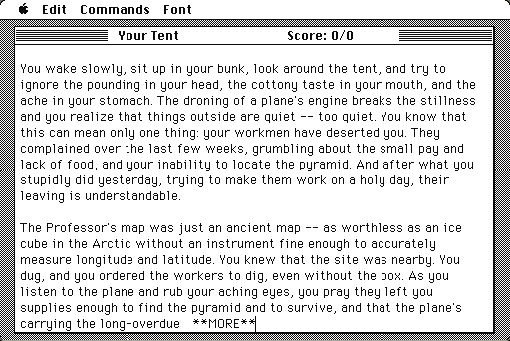
You wake in a tent in the desert with a hangover and no crew. They have taken the supplies and walked out, because you are, as the game establishes in its first few paragraphs, a thoroughly unpleasant person to work for. The pyramid you came to loot is still out there, and you are going in alone.
Infidel is the first of Infocom's "Tales of Adventure" and the one that gets argued about. The puzzles are largely mechanical — hieroglyphs, a sundial, a great deal of careful mapping — and the ending is famous for refusing to reward you.
Boots straight into the game. Start at the tent; the map and the supplies matter.
Controls
| Type + Return | Everything. This is a parser game. |
| LOOK / INVENTORY | Describe the room; list what you carry |
| Commands menu | The verbs the parser accepts |
| SAVE / RESTORE | Save inside the emulated Mac |
Activision owns Infocom's catalogue and still exists. Infidel has not been sold since Classic Text Adventure Masterpieces went out of print in the late 1990s and is part of no current product.
Archives
- Internet Archive — the Macintosh floppy this copy was made from.
How it works & what to expect
| Machine | Macintosh Plus, 512×342, black and white |
|---|---|
| System | The floppy's own — this disk carries the System it shipped with |
| Emulator | Mini vMac, compiled to WebAssembly |
| Release | 22 |
| Saves | SAVE writes inside the emulated Mac, in your browser |
Infidel shipped with a fake archaeological package — a map, a letter, a beaded necklace. Those were physical and are not on the disk. The map in particular is useful; scans of it are easy to find and the game is meaningfully easier with one.
This is a game where you should be drawing your own map as you go. The pyramid's interior is regular and the puzzles depend on knowing which chamber is where.
Why it is remembered
The ending. Infidel finishes in a way that is still, forty years later, the standard example of a game refusing to give the player a victory. Saying more spoils it; it is the reason the game is discussed at all rather than merely remembered.
The protagonist is the villain. Infocom wrote a player character who is greedy, incompetent and disliked, and then made you spend the game as him. Almost nothing else in 1983 was willing to do that.
It is a pure puzzle box. No characters, no combat, no clock — just a structure and your understanding of it. If Deadline is Infocom's simulation, Infidel is its crossword.
Getting started
Search the tent and the camp thoroughly before heading into the desert. What you leave behind you cannot go back for easily.
Draw a map. The chambers look alike in prose and the puzzles assume you know the geometry.
Save in rotating slots. Infidel will let you strand yourself, and a single overwritten save is the usual way a playthrough ends prematurely.
Questions people ask
Are the physical extras included?
No. The map, letter and necklace were items in the box. The game is playable without them, though the map is genuinely useful.
Is the ending really that notorious?
Yes. It is the canonical example of a game that declines to reward the player, and it was controversial on release.
Is there a time limit?
No. Unlike Infocom's mysteries, Infidel gives you as long as you want.
Can I save?
Yes. Type SAVE. Saves live inside the emulated Macintosh in your browser.
Can it become unwinnable?
Yes. Leaving something behind or using a resource wrongly can strand you, so rotate your saves.
Who wrote it?
Michael Berlyn, who also wrote Cutthroats and Suspended for Infocom.